Wednesday, February 8, 2012

I guess size really does matter...


Must one have a penis to win the Pulitzer Prize in fiction? Given that 41 out of the last 58 winners have been men, I’d say, “Not necessarily. But it will certainly increase your chances!”

Jeffrey Eugenides, who gained accolades and a movie sale for his first novel, The Virgin Suicides, was awarded the Pulitzer for his 2003 novel, Middlesex, which concerned the possession of a penis and was excerpted so intriguingly in The New Yorker.

His 2011 novel, The Marriage Plot, has had a marketing push worthy of the second coming, including a much-larger-than-life depiction of the author on a billboard above Times Square, with the headline “Swoon-worthy!” hovering over him. The image has been described as a nerdy version of the Marlboro Man—or Indiana Jones with a seriously receded hairline.

Okay. I’m all for publishers shelling out money to support the sale of novels. A huge Yes to that from me. But this is truly a one-percent situation. The other ninety-nine percent of novelists, in these lean and mean days of publishing, are expected to sink or swim solely through their own efforts and expenditure, blogging till they’re blue in the face and underwriting their own book tours. Their publishers don’t pay for ads, to say nothing of billboards.

Jonathan Franzen has been given similar star treatment—including the cover of Time Magazine. As has the late David Foster Wallace, who was part of the same friendly and competitive cohort of Midwestern novelists that includes Franzen and Eugenides. Wallace, who suffered from clinical depression as well as the usual professional insecurities, one-upped his up-and-coming friends by committing suicide in 2008 and thus assuring his place in the literary pantheon.

Or perhaps not.

In 1944, the critic Edmund Wilson wrote that the most striking thing about the generation of writers that included F. Scott Fitzgerald and Ernest Hemingway was its failure to reach full development. The best writers of the 1920s, he wrote, were canonized too soon: “men of still-maturing abilities, on the verge of more important things, have turned up suddenly in the role of old masters with the best of their achievement behind them.”

I suspect that both Franzen and Eugenides would both cringe with recognition of the relevance of this assessment if applied to their own prematurely stellar careers.

Don’t get me wrong. The Marriage Plot is not a bad novel. Eugenides is obviously very intelligent and very well read. He has an urge toward goodness. And he writes well.

But his descriptions of place seem like movie sets rather than windows onto a living, breathing world. He gives us smugness where we long for something more nuanced and mysterious. And he doesn’t dig deeply enough for his main characters, three recent graduates of Brown University enmeshed in a very conventional love triangle. The heroine, an upper-crust literature major named Madeleine, is just one step above cardboard. One of the two guys in love with her is clearly based on Eugenides himself, trying to make peace with his own nerdiness. Madeleine’s other boyfriend, later husband, is an overly researched, exhaustively described, and ultimately obnoxious genius in the mold of David Foster Wallace.

The character modeled on the author is the most interesting of the three. The novel is all about Mitchell, the Eugenides stand-in, trying to feel good about himself. I think Madeleine’s characterization is so shallow, because Mitchell needs to feel okay at the end about Madeleine’s rejection of him. If she’s not all that great and really not all that interesting, well then, it’s no great loss for Mitchell and he can go on to better things. A Pulitzer Prize, anyone?

In the end, all three characters seem tiresome rather than tragic, hopelessly self-absorbed and somehow unconvincing in their humanity. Try as I might to care about them, I simply couldn’t.

There were all too many passages where it seemed that Eugenides was simply showing off how well read he is. One could cull a terrific reading list for a Great Books curriculum from the works referenced in the pages of this novel.

No, alas, Jeffrey Eugenides is not another Tolstoy, any more than his friend Jonathan Franzen. Nor is The Marriage Plot a great novel, despite the floodtide of money and hype.

But I think what is happening with these writers reveals something profound about the literary world in twenty-first-century America.

We are wrestling with that old fear that the greatest artistic achievements of our civilization are behind us. It is too painful to think that there may never be another writer with the genius and humanity of Tolstoy. And so we hopefully and hysterically anoint new Tolstoy wannabes every ten years or so.

I believe that the writer’s job is to do his or her best work—and to leave it to posterity to judge whether the work will withstand the test of time. To quote Jonathan Franzen’s speech at David Foster Wallace’s memorial, it is the writer’s job “to give love, not just create from the part that wants to be loved.”

Which gets me back to the subject of penises and the Pulitzer Prize.

The entertainment industry—which now includes the literary establishment—is in the business of trying to suss out what people long for. What we want, it would seem, is the literary equivalent of comfort food, as retro as “Mad Men” or the cover of The Marriage Plot, which hearkens graphically back to a more confident and hopeful time for America.

This is a particularly difficult time to be a writer or an artist of any kind—to feel comfortable taking risks, to write what comes from the deepest places inside us, without reference to what we are told will sell.

It’s a really tricky thing for even the best, most talented writers, to live in a society where literary worth is based on – size: of one’s advance, the font used for one’s name on the cover, the ad in the New York Times Book Review. And now, the billboard above Times Square.

Size, I guess, really does matter.

I wrote and recorded this for KRCB's radio program, "A Novel Idea." You can hear the broadcast at http://krcb.org/featured-radio-shows/a-novel-idea
Fast-forward to the 50-minute mark to hear my review!

Saturday, November 19, 2011

The Difference Between a Great Novel and Great Potential

Sometimes, as a lover of the arts, I find myself deeply dissatisfied with something that a whole lot of People Who Matter are praising to the high heavens.

Téa Obreht's The Tiger's Wife is a case in point. Garnering enough honors and prizes to send an octogenarian writer on to the next life with a happy smile, this first novel by a baby-faced 26-year-old just barely missed snagging the National Book Award.

The world is always, it would seem, ready to anoint a young artist as the season’s newest genius. But true genius—like true love, in my opinion—can only prove itself over the course of time. [Click here to listen to listen to my two-minute-long book review of The Tiger's Wife, originally broadcast on NPR affiliate KRCB.]

Thursday, November 17, 2011

Looking for a great new book to read?

As the days get shorter and colder, a lot of us denizens of the Northern Hemisphere want nothing more than a cup of something delicious and a reliably wonderful book we can read by the fire.

I've become the on-air book reviewer for my local NPR radio affiliate, KRCB - and I just happen to have some great new novels and short story collections to recommend to you and your reading group, should you belong to one.

Over the next few days I'll post mp3 files of my favorites. Click and listen. Each review is only two or three minutes long.


What a joy to find a work of fiction as beautifully luminous and utterly engaging as Jean Thompson’s new novel, The Year We Left Home.

The story of one Iowa family, this novel left me agog with admiration for Ms. Thompson’s mastery of the craft of writing [...] Please listen to my full review here.

Thursday, June 23, 2011

A Blog Tour Sampler

How the world has changed in the four years since my last novel, Vivaldi's Virgins, was published! It's as if a good media fairy waved her magic wand and brought into being dozens and dozens of bright and avid young book reviewers all around the country. Instead of a few overworked publicists at each publishing house struggling to spread the word about their assigned authors, there is a legion of dedicated and generous bloggers out there, beautifully and imaginatively writing (for free!) about the books they love.

Three cheers from me and my fellow authors for all the young adult book bloggers who host guest authors on their sites and challenge them with some of the most imaginative assignments the world of book publicity has ever seen!

To give you a taste of the creativity, discernment and love of reading invested in these wonderful YA blogs, here are some excerpts from a few of them:

Alessandra Giliani, the heroine of A Golden Web (impersonated by me), was asked:
"What is your favorite surgical tool?"
Go to Erika's blog for the answer.

"I know I'm not alone in this, but I really enjoy the stories where girls dress up as boys to reach their dreams. I like to think that if I had lived back in the 'olden days' that I would have been that hard core, that I would have been able to cut off all my pretty hair and disappear into the world. I don't know if I would actually have been able to do it, but I really like reading about girls who are." - Ashley.
Read more on Ashley's blog.

"J.M. Barrie, who wrote Peter Pan, claims that babies all remember once having been fairies. They’ re still trying to fly, waving their little arms. But life teaches them soon enough how silly they’ re being—and they stop trying to fly. Writers are often, I think, babies who never learn that they can’ t fly anymore. From a very young age, I knew I needed wings of some kind if I was going to survive the journey to adulthood. I kept my wings hidden. But I flew nonetheless. I found safe and beautiful places. And when I couldn’t find them, I created them." - From the 250-word biography I was asked to write for Christie's blog.

Please check back here as I add more posts from these extraordinary young women.

Tuesday, June 21, 2011

Touring in Cyberspace: Part 3

I promised photographs...

The parade of kids dressed as manga characters in Düsseldorf’s Japantown


Still the city of my dreams: Paris!


Our unbelievable hotel room in Barcelona
(no martinis were made or consumed)


Climbing among the ruins of a castle in Molina de Aragon...


All this while my virtual self was touring 28 different young adult book sites. Viva the Blog Tour!

Friday, June 17, 2011

Touring in Cyberspace: Part 2

Oops! I just counted: there were 28 (not 16) stops on the blog tour for A Golden Web.

The whole thing started last October, when a YA book-lover named Sandy, author of a blog called Pirate Penguin Reads, apparently recommended my novel to an all-volunteer, three-girl Internet organization called Teen Book Scene.

Would I like to have my debut YA novel featured on a blog tour? Would I ever! I wrote to Kari and Corrine.

We decided to wait until the spring, when the paperback edition of the novel was due to be published. That seemed a good time to launch a blitz of publicity.

Meanwhile, I went to Italy to do research for a screenplay, tagging along with my fiancé, a violist, on the San Francisco Symphony’s fall tour.

By the time spring rolled around, I had more or less forgotten about what suddenly seemed like a completely cavalier promise to give 28 different bloggers a piece of myself—an interview here, a 250-word biography there. Three video interviews for which I served as producer, talent, set dresser, make-up artist and videographer until my ex, who is a professional, kindly stepped in to save the day. Interviews in which I was to “be” one of my characters. Revelations about “My Secret Life,” my “Ten Favorite Disguises,” what you would be likely to find at a garage sale of stuff I had as a teenager—and on and on.

It was all marvelously imaginative, on the part of the bloggers. And tremendously time-consuming for me. When it came to trying to figure out how to use the camera on my computer to make a movie of myself and post it on You-Tube, I thought my brain would explode.

I was still writing my bits and pieces for the blog tour when I joined Wayne for the last ten days of his actual tour—the Symphony’s spring tour in Europe.

And so I was sitting in a Spanish cafe in Düsseldorf’s Japantown, watching a fantastic parade of German kids dressed as manga characters milling up and down the street like something from a jet-lagged dream, when the first video interview went live on Cindy’s blog.

My virtual self was tossing off character interviews while my actual self (in red high heels) listened to my sweetheart playing Mahler in Paris.

Kelsey, Kayla, Melissa, and Jessica blogged about my book while I ate gaspacho in Barcelona.

More split in two than my Gemini self has ever been, I was a guest on Danna’s site even as I climbed among the ruins of a castle in Molina de Aragon.

And finally, in Madrid, I solemnly wrote on Kathy’s blog why I could not conceive of my characters tweeting—how the only creatures who tweeted in the 14th century (when A Golden Web takes place) were the birds in the trees.

After the Symphony moved on from the unbelievably gorgeous public spaces of the Palace Hotel to their next all-too-brief gig in Lisbon, I moved into a much more modest lodging for my last night in Madrid at a clean and spare little hotel called Miau (with the face of a cat on their logo).

For the first time since embarking on the Symphony tour, I had free Internet in my room, which had windows that opened and its own little balcony looking out over the Plaza de Santa Ana. I walked all over the city in a light rain, ate a supper of tapas and returned to my room to write my last post, for Jessica at her Hopelessly Devoted Bibliophile blog: “What I Do When I’m Not Writing.”

In my hodgepodge of Latin languages that will have to serve me until I get serious about learning Spanish, I asked the cab driver who picked me up at 7 a.m. about the name of the neighborhood where I had quite arbitrarily chosen to lodge. He told me that it was the barrio de las letras, the writers' quarter. Cervantes himself lived on a neighboring crooked little street. I'd noticed, the night before, as I walked around in the rain after supper, taking my last photos, that those streets were lined with bookstores.

Back at home and utterly jeg-lagged, I didn’t feel that I needed to watch the You-Tube version of myself answering Kari’s questions for A Good Addiction—although I did revel in reading the thoughtful, appreciative and sometimes wildly ecstatic reviews of my book written by Ashley, Danna, Lexie, Melissa, Julia, Kathy, Britta, Kayla, Jessica, Christie, Erika, and Cindy.

What I would have done for a dozen such friends and supporters when I was a lonely girl in high school!

Come back tomorrow for my final post about Touring in Cyberspace, along with some photos!

Thursday, June 16, 2011

Touring in Cyberspace: Part 1


It’s a whole new game, being an author today.

Take going on tour. Used to be, you’d get a fat packet of airplane tickets from your publisher. You’d put a lot of thought into what you put in your suitcase, making sure you got everything into your carry-on. You’d walk off the plane and there’d be someone waiting for you at each airport, holding a sign with your name on it.

You’d get into a car and were zipped off somewhere to an event where there might or might not be people clamoring to hear you read your work and have their books signed. You slept in a hotel in a place you might never have seen before and might never see again—or, if you were lucky, you’d arranged to stay with some long-lost friends.

If your publicist did a really good job, you were booked as a guest on some local television shows, which required you to have a whole lot of make-up brushed onto your face at an ungodly hour of the morning—and to be articulate and funny, if possible, hours before your brain’s usual time for revving up into high gear.

Well, you can forget about all of that now if you’re what is called in the industry a mid-list writer—someone, like me, who has a few fans here and there but isn’t someone whose name is a guaranteed draw for big crowds.

In this time of pinched budgets and blockbuster mentalities in the publishing world, the Blog Tour has come to be the standard for letting readers personalize their experience with writers.

You may be the most avid and devoted reader, but you won’t get your book signed. You won’t sit nervously in the little crowd of people in the bookstore’s designated space for public readings, trying to formulate just the right words for your question. If you’re an aspiring writer hoping to get a quote for your manuscript or just a crumb of encouragement, you’ll miss out on the chance to see that published writer eye to eye—how she dresses and whether she wears reading glasses and whether her author photo is ridiculously out of date.

But if you have a blog, you can command that same author to spend hours, if need be, producing a piece of original writing for you. And you can bet your laptop that the writer will be grateful and gracious about doing your bidding. Because you’re giving him or her what publishers have stopped providing for all but the already famous: Publicity.

Come back and visit tomorrow to read about what it’s like to do a tour of 16 different young adult book blogs.

Wednesday, May 11, 2011

A Transplanted Writer


We really are what we eat—and not just in the usual way suggested.

Yesterday I transplanted a dozen or so baby golden turnip starts from a recycled pony pack into my vegetable garden. I’d been careful to sow just two or, at most, three round little seeds into each of the linked soft-plastic receptacles, reasoning that not all of them would germinate. And yet all of them did, and I was faced with the delicate job of untangling the roots that had intermingled in each crumbling cube of soil I popped out of the pack.

So it is when we transplant ourselves from one place to another.

Disentangling ourselves from the familiar mesh of everyday life as we’ve known it is a terribly tricky operation. Having the confidence to believe that we’ll find a nurturing environment in the cold soil of an unknown place is an act of hubris and faith.

Two summers ago, after over 30 years of living in the East Bay, I moved to the Wine Country of Northern California to start a new life. My son was about to leave for college. I was embarking on a shared life after having been single since just before my son started kindergarten.

I had no idea how tangled my roots were in the lively, urban, multi-ethnic soil of the Bay Area. Suddenly the bicycle I used to ride every day to little markets and the outdoor cafes where I did so much of my writing was gathering cobwebs. The dance classes, so abundant in Berkeley, were nothing more than rumors here. I used to see my neighbors every day on my way in and out of my little Craftsman bungalow. Here the people who live on nearby properties wave to me sometimes, as I’m out working in the garden. But mostly, it seems, people don’t really know each other so much as they know of each other—and all of us keep our distance.

I worked hard to cure myself of the crushing sense of loneliness I felt when Wayne was in the City all day and all evening, rehearsing and performing with his community of 100 colleagues while I was here with my own solitary work and the cat.

Well, it has been nearly two years and I’ve begun to find my feet here. I’m a regular now at two dance classes that feature live drummers. The local NPR station, KRCB, has asked me to start doing some on-air book reviews. And, loveliest of all, I’ve made some friends.

It’s hard, when one has been planted in the same pot for a very long time. In fact, it’s terrifying to have all one’s most vulnerable needs exposed to light in that endless-seeming moment of transition. Will I thrive again? Will all my leaves fall off first? Will I ever manage to blossom here?

Happily, I can answer, Yes!
 

Friday, October 29, 2010

Summer's Last Gifts

 
The Harvest

I’m grateful to Nature
for making the strawberries red.
They’re so much easier to find that way.

Same thing with the tomatoes:
Parting a thicket of fragrant leaves,
I spy them, slick with the rain that will be
their ruin if I don’t harvest today.

It’s like reaching into another dimension,
up to my shoulder, nose pressed against
the hairy stems. Fingers stretching
to cup the red and yellow globes
filled with seeds, as sweet
and acid as love.

                                    —Barbara Quick

Thursday, September 30, 2010

The Grapes Are In!

This frog is following me!
Imagine harvesting grapes by moonlight, in the wee hours, with Jupiter shining as brightly as a beacon in the night sky (closer to Earth now than it’s been in over half a century).

Let’s pass over how you look: You’re jet-lagged, you haven’t had coffee or even washed your face, and it is, for godssake, 3:30 in the morning. Plus, you and Prince Charming are both wearing halogen head-lamps held on to your bed-heads with crisscrossing black elastic bands. (I doubt it’ll become a fashion trend any time soon.)

The idea is to harvest the grapes while they’re cold, when the sugar is just right, and before the spate of hot weather turns them to raisins.

There’s a four-hour window of time before the violist-vigneron has to leave for his rehearsal in San Francisco.

Nature is already playing its symphony: frogs, crickets, birds. The lonely sound of middle-of-the-night traffic on the Gravenstein Highway. Our two pairs of grape scissors snipping. (Try saying that 10 times in a row!) The satisfying plunk as the clusters pile up in the grape tray.

When the tray is full, you stumble with it, in the dark, down the rows, over the clods of earth, trampling weeds and peppermint. Trays weighed, weight of each one noted, and then back into the vineyard to start again.

After two hours in the damp and cold, your hands hurt. After three hours, you have a renewed sense of respect and admiration for Cesar Chavez. The closest you have ever come to this labor is Labor: that other middle-of-the night long haul with magical consequences.

It takes two consecutive days of waking in the dark and working until the sun has made the light on your head unnecessary. But, together, you gather all the fruit: 584 pounds of Pinot noir and Pinot gris.

It’ll make about 180 bottles of wine. Santé!

Barbara Quick, Vivaldi's Virgins Book Signing

Barbara Quick, Vivaldi's Virgins Book Signing
Barbara Quick

My Garden

My Garden
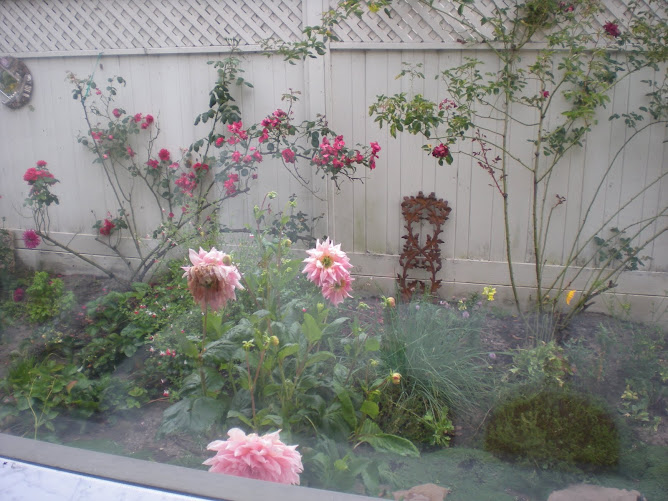
My flower and strawberry garden (bathtub view)

Books

Books